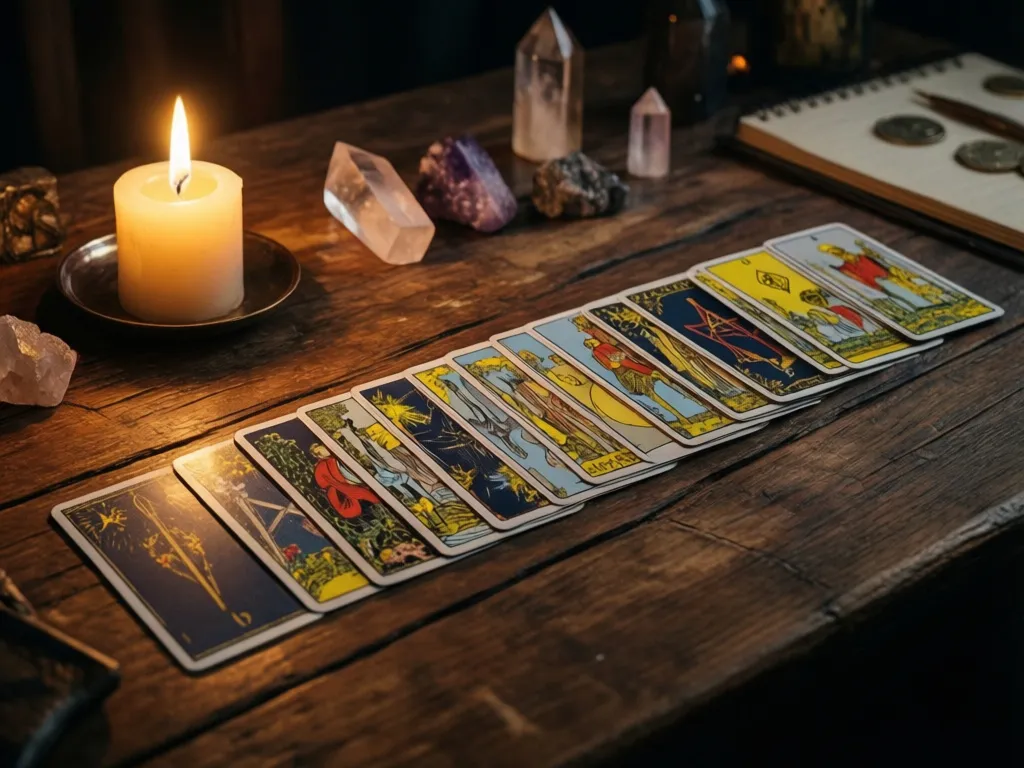
Number One – The Seed of Initiative
One represents the spark of potential. In tarot it is the energy that starts a cycle, urging forward motion. The card that most directly embodies this vibration is The Magician, a figure who channels raw will into concrete form. Core themes include new beginnings, confidence, and the power to manifest personal intent. When a one appears in a spread it often signals a moment to claim personal authority and act on a fresh idea.
Key Themes
Leadership, independence, focus, the ability to translate thought into action.
Corresponding Cards
The Magician, Ace of Wands, Ace of Swords.
Number Two – The Balance of Duality
Two introduces relationship and contrast. It reminds us that every action contains an opposite, creating a dance of give and take. In the major arcana The High Priestess exemplifies the mystery of inner versus outer knowledge, while the Two of Cups highlights partnership. This number asks the querent to consider harmony, choices, and the need for cooperation.
Key Themes
Partnership, choices, polarity, the need for alignment.
Corresponding Cards
The High Priestess, Two of Cups, Two of Pentacles.
Number Three – The Growth of Expansion
Three marks the first stage of development beyond the seed. It is the point where ideas begin to take shape and spread outward. The Empress in the major arcana is the archetype of nurturing growth, while the Three of Pentacles celebrates collaborative creation. This number signals that a project is moving from concept to tangible form.
Key Themes
Creativity, teamwork, manifestation, the emergence of structure.
Corresponding Cards
The Empress, Three of Pentacles, Three of Wands.
Number Four – The Foundation of Stability
Four brings solidity and order. It is associated with the establishment of boundaries and the creation of a reliable base. The Emperor embodies disciplined authority, and the Four of Coins reinforces the notion of security through material control. When four appears, the focus is on building lasting structures.
Key Themes
Stability, discipline, organization, the need for security.
Corresponding Cards
The Emperor, Four of Pentacles, Four of Swords.
Number Five – The Challenge of Change
Five introduces tension and conflict, the necessary friction that drives evolution. The Hierophant, as a teacher of tradition, can be challenged by the Five of Wands’ competitive energy. This number invites the querent to confront obstacles, adapt, and learn from disruption.
Key Themes
Conflict, adaptation, freedom versus restriction, learning through struggle.
Corresponding Cards
The Hierophant, Five of Wands, Five of Cups.
Number Six – The Harmony of Balance
Six restores equilibrium after the turbulence of five. It reflects a state of harmonious exchange, often represented by The Lovers, which illustrates the integration of dual aspects into a unified whole. The Six of Pentacles also illustrates generosity and the flow of resources. This number speaks to cooperation and the reward of prior effort.
Key Themes
Harmony, generosity, partnership, the reward of effort.
Corresponding Cards
The Lovers, Six of Pentacles, Six of Cups.
Number Seven – The Quest for Insight
Seven is the seeker’s path, a journey toward deeper understanding. The Chariot represents focused will, while the Seven of Swords signals strategic thinking. This number asks the querent to look beyond the obvious, to trust intuition, and to pursue inner truth.
Key Themes
Reflection, intuition, strategic planning, inner wisdom.
Corresponding Cards
The Chariot, Seven of Swords, Seven of Cups.
Number Eight – The Power of Mastery
Eight signals skillful execution and the mastery of cycles. Strength, as a major arcana, illustrates the controlled use of inner power, and the Eight of Pentacles reflects diligent craftsmanship. This number encourages the querent to apply learned abilities toward concrete outcomes.
Key Themes
Mastery, perseverance, skill development, disciplined effort.
Corresponding Cards
Strength, Eight of Pentacles, Eight of Wands.
Number Nine – The Completion of Experience
Nine represents fulfillment and the nearing of a cycle’s end. The Hermit, with his lantern, embodies the insight gained after a period of introspection, while the Nine of Cups is often called the wish card, signaling emotional satisfaction. This number asks the reader to assess what has been achieved and what still remains.
Key Themes
Fulfillment, introspection, emotional contentment, evaluation.
Corresponding Cards
The Hermit, Nine of Cups, Nine of Pentacles.
Number Ten – The Cycle’s Resolution
Ten culminates the numeric journey, bringing the lessons of the previous numbers into a final synthesis. The Wheel of Fortune illustrates the turning of destiny, and the Ten of Swords marks the end of a painful chapter, clearing space for renewal. Ten invites the querent to recognize closure and to prepare for the next cycle.
Key Themes
Completion, destiny, finality, the promise of renewal.
Corresponding Cards
The Wheel of Fortune, Ten of Swords, Ten of Cups.
Leave a Reply